|
Brush for Oil Painting |
|
|
|
Brush for Oil Painting |
|
Oil Painting Brushes
Brushes are an important tool for painting and it is false economy to buy cheap ones.
Buy the best you can afford, respect and look after them well and they will last for many years.
|
|
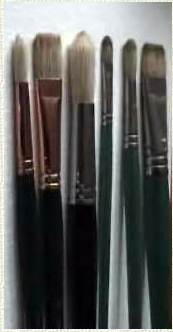
Bristle brushes for Oil painting and how they are made. Artists brushes are hand made and for the oil painter finest 'Chungking' if often the preferred bristle, because it holds the paint well and has plenty of spring. Natural bristle does not come to a point, it actually has two or three splits at the end, these are called 'flags'. This allows the bristle to hold more paint, with use, the flags often change colour having been stained by strong pigment, but this has no detrimental effect on the brush. The bristle is cleaned, sorted, sized, sterilized and wrapped into bundles for each brush, this is then hand tied and then 'cupped' to form the various shapes. The bristle is then set into the metal 'ferrule' using a special type of resin glue. The best ferrules are seamless nickel-plated copper and they contribute to the size, balance and shape of the brush. |
Standard brushes for oils are:- Filbert - is a flat brush with the tip having an oval shape like a filbert. Bright -flat brush with a short length of bristle. Flat - flat brush with a long length of bristle. Round - round brush shaped like a bullet which comes to a blunt point. Fan - shaped like a fan. For more information about brushes and brush shapes and the different filaments available for oil painting have a look around the net, lots of website with a wide assortment. |
 |
 |
Besides using bristle brushes for oils, you can use Sable, Sable synthetic mix or synthetic. Brush shapes in general use are:- Round; One-stroke; Flat and Rigger. Mop and Wash brushes are used for blending. The effect you wish to create dictates the choice of shape and filament, The Sable and Sable/synthetic mix will usually give a softer, smoother look to the applied paint. This mixture of filament is also useful for detail work and where finer brush strokes are needed. |
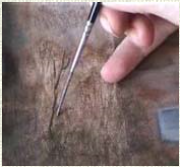
The synthetic mixtures range from soft to bristle effect and are a good alternative to natural hair filament. Each type has its place and it's important to find out which type suites you, the way you work and the effect you wish to create. Working with different brushes is only real way to find out what is right for you. The example on the right is a Rigger brush, a mix of sable and synthetic filament, loaded with thin paint it is ideal for fine lines and things like twigs and branches. |
 |
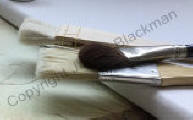 |
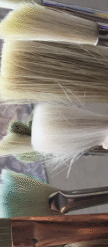
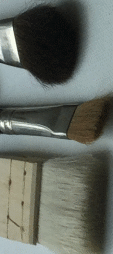
The soft brushes like Mops, Hakes and Wash are used a lot in oil painting for blending paint, it often only takes a gentle use of the brush to blend the paint surface. They are made with a much softer hair or filament that allow for a delicate touch and movement of the paint. |
|
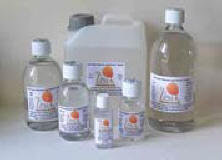
Brushes are the 'tools' of your 'artistic' trade and it is very easy to ruin them if they are not looked after properly. Brushes need to be cleaned after each painting session, a good cleaning routine will pay dividends. Use either of these products for brush cleaning Zest-it Oil Paint Dilutant and Brush Cleaner or the Zest-it Solvent (Citrus Free)
|
|
Copyright 1999 - 2023 © J. & T. Blackman Ltd. All Rights Reserved Worldwide.
The information contained herein is the Intellectual Property of Jacqui Blackman and
J. & T. Blackman Ltd., and is supplied without liability for errors or omissions.
Zest-it ® and its logo are Registered Trademarks.
No part may be reproduced or used except as authorized by contract or other written permission, unless stated otherwise.
The copyright and the foregoing restriction on reproduction and use extend to all media in which the information may be embodied.