|
Painting and Palette Knives |
|
|
|
Painting and Palette Knives |
|
Using Painting and Palette knives in Oil painting.
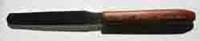 |
Palette knives:- have a solid blade from handle to tip and the tang/tongue (insert) should extend completely through the handle. The blade is usually forged steel, flexible and blunt. The handle is made of hardwood and the blade is usually straight. They are designed to be used for mixing paint and cleaning paint from the palette. |
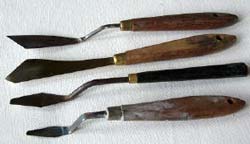
Painting knives:- traditionally have a narrow cranked arm to the blade as shown in the examples right, this allows them to be flexible, light in weight and helps to keep the knuckles of the hand, out of the paint when in use. There are others that have a straight solid blade; these generally have an angled square end to the blade. The blade is forged steel tempered along its full length giving flexible stiffness, with the 'tang' extending through the handle. |
 |
 |
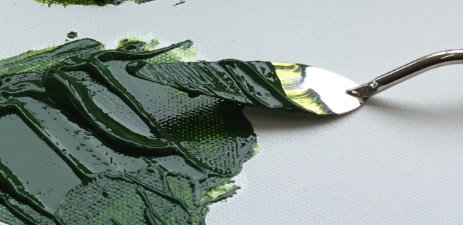
Painting knives are used for applying paint to canvas, especially where an impasto (thick, rough) effect is required. Very useful where a straight edge is needed or a sharply defined line. When first starting to paint with a knife, the 'Trowel' shape is probably the best to choose as it is a useful shape and easy to handle. Think of it 'like spreading jam onto bread and butter'. It is best to keep the knife clean between applications this helps to reduce the muddying of the colours. Paint applied without too much mixing is very effective. |
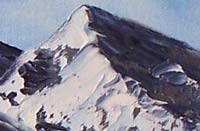
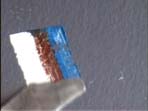
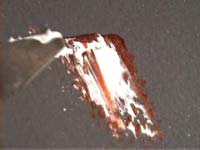
As shown right, more than one colour can be added to the knife, this can be especially useful where large sweeps of are colour are needed - an expanse of flat water for instance or the side of a building. Practice different ways of loading the knife and different actions when applying the paint. Try and develop a light touch when applying the paint, too much pressure and the paint will be removed as fast as you try to apply it. The edges of the blade should not be too sharp, a blunt, smooth edge is often the easiest to work with, if it appears too sharp, dull/blunt it by rubbing on fine 'wet and dry' emery paper. A sharp edge can damage the primed surface of the canvas and even cut into the fabric. Test the blade by picking paint up from a palette, it should cut through and lift the paint with a smooth feel against the palette. |
  |
 |
Would you consider that using a Painting knife has anything to do with the 'Building trade'? If you have the opportunity to watch a skilled person laying bricks or plastering a wall, their expertise and dexterity with the tools of their trade are what you are after with the tools of yours! Using a painting knife you are building up layers of paint; make sure your 'building' stands the test of time. |
|
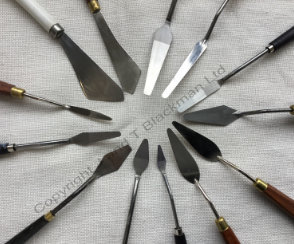
"Painting Knives"! All manner of other useful types of blades can be tried, a wide selection can be found in the 'clay modelling' section of an art shop, from spatulas to wire tools. Try experimenting with household tools you have on hand, the main thing to remember is that the edge of the blade needs to be blunt, otherwise there is the risk of cutting the canvas. The image right gives a good indication of the shapes and styles of painting knives that are available. More information on knives is available at www.artywax.co.uk/knives.htm |
|
Copyright 1999 - 2023 © J. & T. Blackman Ltd. All Rights Reserved Worldwide.
The information contained herein is the Intellectual Property of Jacqui Blackman and
J. & T. Blackman Ltd., and is supplied without liability for errors or omissions.
Zest-it ® and its logo are Registered Trademarks.
No part may be reproduced or used except as authorized by contract or other written permission, unless stated otherwise.
The copyright and the foregoing restriction on reproduction and use extend to all media in which the information may be embodied.